
Supplement Tracker App Statistics 2026
Clear, combined statistics about the supplement industry are hard to find. Label data, certification claims, recalls, and lawsuits are scattered across separate databases — there's no single place that puts them side by side. And nobody publishes what shoppers actually do with any of it. So we built our own: we parsed the labels of 138,239 supplements, scored 143,641 products, pulled the public enforcement record for 8,784 brands, and watched how 1,001 people shop for them — 9,038 barcode scans and 5,693 searches. The first half of this page is what people do; the second half is the market they do it in. Every stat has a copy button — use them anywhere, just keep the attribution.
How people actually shop for supplements
Every figure in this section comes from GoodSupp app usage — 1,001 people, 9,038 barcode scans. It is a small, self-selected group of people who chose to install a supplement scanner. Read it as behaviour inside that group, not as the general public.
5
The typical supplement-tracker user scans 5 products. The average is 9.0 — dragged up by a long tail.
Source: median across 1,001 users and 9,038 scans.
48.2%
48.2% of all supplement scans come from the heaviest 10% of users; 19.9% of people scan once and never return.
Source: 9,038 scans across 1,001 users.
46%
46% of supplement scanning sessions involve three or more products — people compare in the aisle, they don't just look one thing up.
Source: 2,177 sessions (scans grouped by gaps under 15 minutes); average 4.2 products per session, largest 87.
When people check their supplements
Supplement research turns out to have a clock and a calendar. Scanning is a daytime activity that peaks around lunch and again after work, and it is busiest at the weekend — the shape of shopping, not of late-night worrying.
74.3%
74.3% of supplement scans happen between 9am and 9pm local time; only 2.7% happen overnight.
Source: 8,984 scans, local time approximated from location.
Sunday
Sunday is the single biggest day for supplement scanning, and weekend days run about 32% busier than weekdays.
Source: 8,984 scans; 34.6% fall on Saturday or Sunday.
People don't accept a score. They open it.
This is the finding that surprised us most. We expected a quality score to be the end of the interaction — look, judge, move on. It isn't. Opening the score breakdown to see which ingredient, dose or certification drove the number is the single most common thing users do in the app. It happens more often than scanning.
76%
76% of people who scan a supplement open the score breakdown to see why it scored what it did.
Source: 760 of 1,001 scanning users.
1.08
Supplement shoppers open 1.08 score explanations for every product they scan — more explanation views than scans.
Source: 9,794 score-breakdown views against 9,038 scans.
Take that seriously and a lot of industry convention looks wrong. A letter grade or a star rating with nothing behind it isn't what people want; they want the reasoning, and they go and get it.
How people search: ingredient first, brand second
There are two ways to shop for a supplement — decide what molecule you want, or decide whose bottle you trust. We can see which one people actually do, because we can read the search box.
66.3%
66.3% of supplement searches are for an ingredient, not a brand — people shop by what's in it, not who made it.
Source: top 66 search terms (1,104 searches) classified against GoodSupp's 8,784-brand database.
Magnesium
Magnesium is the most-searched supplement among GoodSupp users, ahead of creatine — and it isn't close once its forms are counted together.
Source: 5,693 in-app searches by 577 users.
Top 3
Nature's Bounty, Nature Made and Sports Research are the 3 most-scanned supplement brands among GoodSupp users — too close together to rank, and clearly ahead of the rest.
Source: 2,504 barcode scans matched to a brand.
37.3%
Plain vitamins account for 37.3% of all category browsing — ahead of fish oil, collagen and probiotics combined.
Source: 2,143 category views by 685 users.
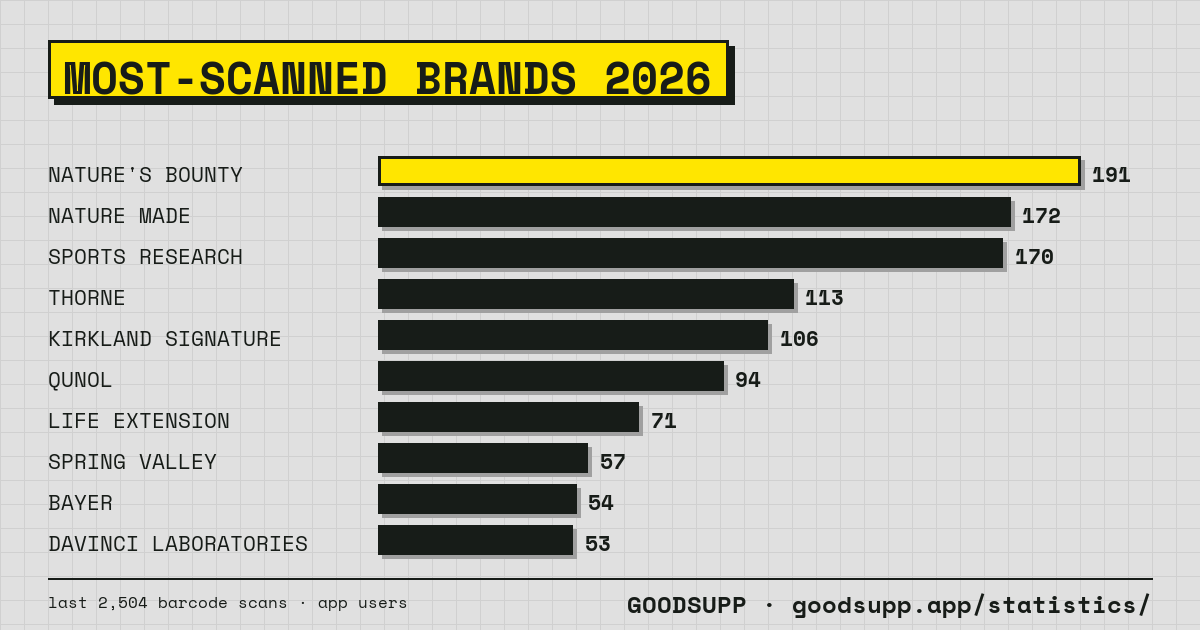
On the brands: those top few are statistically tied with each other and we won't invent a winner. They are clearly ahead of everything below them, which is the part the data actually supports.
Does better information change what people pick?
The question worth asking of any scoring app is whether it changes anything. When someone scans a supplement, GoodSupp can offer a better-scoring alternative. Here is what happens when they tap it.
+22.4
When users move from a scanned supplement to an alternative, the alternative scores 22.4 points higher on average — 76.8 to 98.9 out of 100.
Source: 324 taps across 134 scanned products; 95% confidence interval +20.3 to +24.1.
132/134
In 132 of 134 cases, the alternative someone moved to scored better than the product in their hand.
Source: 561 alternative taps by 137 users.
One honest limit on that number: GoodSupp algorithmically chooses which alternatives to show, and it surfaces high scorers, so the 22-point gap measures our recommendation plus the user's willingness to act — not independent consumer judgement. What is unambiguously the user's own behaviour is which products send them looking in the first place, and those score below the average supplement people scan.
What people actually own, vs what's on the shelf
Everything above is what people do. The rest of this page is the market they're doing it in — and this section is the hinge between the two. We took the supplements our users actually scanned and ran them through the same analysis as the whole catalogue. The two populations are not the same, and not always in the direction you'd expect.
80.4
Supplements people actually scan average 80.4/100 — above the 76.5/100 catalogue average. People buy better than the shelf.
Source: 345 scanned products scored; 95% confidence interval 78.8–81.9.
2.6%
Only 2.6% of the supplements people scan hide doses in a proprietary blend, against 6.9% of the catalogue.
Source: 345 scanned products vs 138,239 catalogue labels.
5.7%
5.7% of the supplements people scan contain titanium dioxide — higher than the 3.5% catalogue rate.
Source: 345 scanned products vs 138,239 catalogue labels.
That last one cuts against our own additives section below, so it's worth stating plainly: on titanium dioxide, real purchases are worse than the market average, not better. The likeliest reason is that the coated tablets from big mainstream brands are what people actually buy. We publish it because it's what the data says.
Additives: the industry default, not the exception
We parsed the "other ingredients" list on 138,239 supplement labels. The labels themselves are public — NIH's Dietary Supplement Label Database publishes more than 178,000 of them — but nobody publishes the totals, so we counted. Short version: additives aren't the exception. They're the default.
26.4%
26.4% of the 138,239 supplement labels GoodSupp analyzed list magnesium stearate, a manufacturing flow agent.
Source: 36,544 of 138,239 product labels analyzed by GoodSupp.
8.4%
8.4% of the 138,239 supplement labels GoodSupp analyzed list sucralose, an artificial sweetener.
Source: 11,644 of 138,239 labels analyzed.
3.5%
3.5% of the 138,239 supplement labels GoodSupp analyzed still list titanium dioxide. The EU withdrew it from authorised food additives in 2022; the FDA still permits it and has it under post-market safety review.
Source: 4,783 of 138,239 labels analyzed. EU Regulation 2022/63 ↗
3.3%
3.3% of the 138,239 supplement labels GoodSupp analyzed list artificial colorants such as Red 40, Blue 1, or Yellow 5.
Source: 4,509 of 138,239 labels analyzed.
To be clear: all of these additives are permitted in US supplements, and titanium dioxide is the only one an EU withdrawal applies to. The problem is you can't see the pattern from one bottle. Standing in the store, you have no way to know that roughly three-quarters of the alternatives skip the stearate entirely. We can see it, because we read all the labels.
Transparency: blends, doses, and what scores reveal
A label can list every ingredient and still tell you nothing. The trick is called a "proprietary blend": name the ingredients, hide the doses, print one combined number. It's legal. Here's how often it happens.
6.9%
6.9% of the supplement labels GoodSupp analyzed hide doses inside a proprietary blend.
Source: 10,223 of 148,166 products with a parsed ingredient panel.
7.5%
7.5% of supplements score below 60/100 on independent quality analysis; the catalogue average is 76.5/100.
Source: 143,641 products scored by GoodSupp's methodology.
Certifications: two kinds of claim, and only one you can check
"Third-party tested" is printed on a great many bottles, and it does not mean one thing. Some brands name a certifier that publishes a public list — NSF, USP, Informed Sport, USDA Organic — and anyone can look the brand up in a minute. Others say they're tested without naming anyone, or point at a private lab report. That report may well exist and be perfectly good. It is also not published anywhere, so no shopper can ever see it. We sorted 3,905 claims into those two piles.
24.3%
24.3% of the quality claims supplement brands make cannot be checked by anyone — no certifier publishes a list to check them against.
Source: 949 of 3,905 claims name no certifier with a public registry.
655
The most common single quality claim is GMP manufacturing backed by FDA registration — but the FDA registers facilities, it does not certify them, and publishes no list of approved ones.
Source: 655 brands make this claim; FDA registration is an administrative filing, not an inspection result or an endorsement. FDA on dietary supplements ↗
89.7%
Where a brand does name a testing certifier with a public registry, the claim checks out 89.7% of the time.
Source: 621 of 692 testing claims confirmed in the certifier's own database.
That last number matters, and it cuts against the easy story: when a supplement brand names a real certifier, it is usually telling the truth. The problem isn't mass lying. It's that 24.3% of claims are built so that honesty and dishonesty look identical from the shop floor — and nothing about the label tells you which pile you're holding. Two housekeeping notes, because they affect the numbers above: we exclude 683 claims our own lookup never ran against a registry, rather than count our gap as a brand's failing; and a claim we couldn't confirm is not a claim we disproved.
Enforcement: the public record
Supplements get regulated after the fact — the FDA steps in once a product is already on shelves. The paper trail exists, but it's scattered across court records, recall notices, and California Prop 65 filings that nobody reads. We compiled what we could find for the 7,328 brands we have researched so far. Everything below counts our own dataset, not the complete public record — the real totals are larger.
21.2%
21.2% of researched supplement brands have at least one public violation on record — a lawsuit, recall, FDA warning, or Prop 65 notice.
Source: 1,556 of 7,328 brands researched; 3,805 records total.
77.1%
Among the biggest brands — those with 100+ products — 77.1% carry a public violation, against 8.6% of the smallest. Enforcement records track company size more than anything else.
Source: 195 of 253 large brands vs 394 of 4,555 brands with fewer than 5 products.
1,362
1,362 lawsuits involving supplement brands are on public record in GoodSupp's violations dataset.
Source: Court records and contemporaneous coverage, each linked to its source.
1,132
1,132 California Prop 65 notices against supplement products for heavy metals or listed chemicals are in GoodSupp's dataset.
Source: across 7,328 researched brands; California receives thousands of notices a year across all consumer categories, so this is a subset. CA AG 60-day notice search ↗
725
725 supplement product recalls are on record across the brands GoodSupp has researched.
Source: FDA enforcement reports and company announcements, across 7,328 researched brands. FDA recalls database ↗
586
586 FDA warnings and warning letters to supplement brands are in GoodSupp's dataset.
Source: FDA warning-letter database, across 7,328 researched brands; the FDA issues these continuously, so this is a subset. FDA warning letters ↗
Every record is stored with a link to its source document, and 245 of them have had that link re-checked as still resolving. The full report — which names brands, and only where the source link has been independently re-verified — is in the violations report.
Where these numbers come from
Label data is parsed from product packaging across 138,239 supplements. Scores come from our published methodology. Certification claims are checked against the certifiers' own public databases — NSF and USP among them. Violations are compiled from public records — court filings, FDA letters, recall notices, Prop 65 filings — each linked to its source. App-behaviour numbers come from GoodSupp iOS app analytics (event counts only, no personal data), covering February to August 2026.
Cite as: "GoodSupp, Supplement Tracker App Statistics 2026, goodsupp.app/statistics/". Journalists: underlying counts and queries available on request via the contact page. Check any product yourself with the free label decoder or the GoodSupp app.